

 Select a city
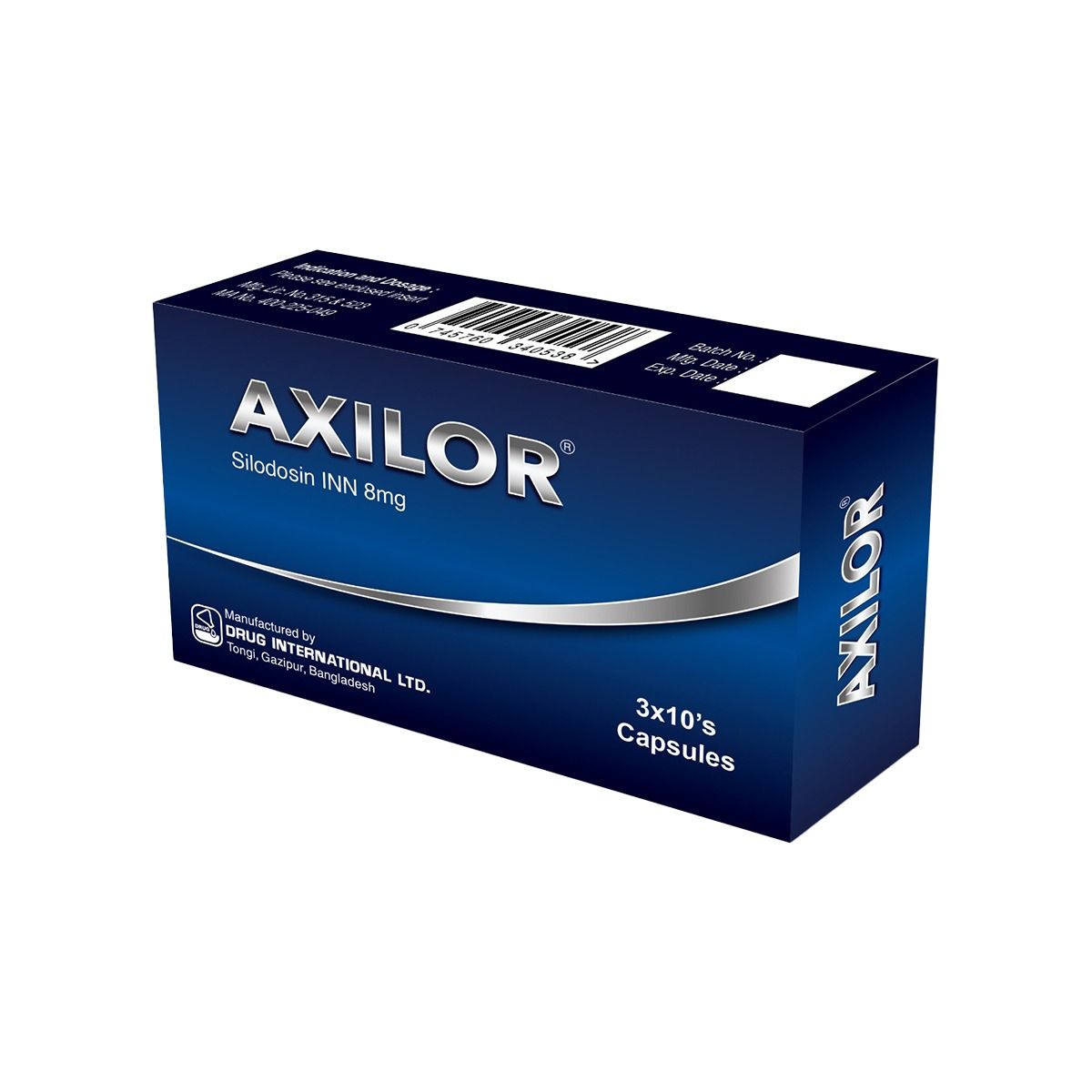
Axilor - Axilor Oral 8mg 30 Capsules
| Status | Select a city |
| Brand country |  Bangladesh |
| Quantity and shape | 30 capsules |
| Generics | silodosin |






- Description
- Reviews
1. Name of the medicinal product
Axilor 8 mg hard gelatin capsules
2. Qualitative and quantitative composition
Each hard gelatin capsule contains 8 mg silodosin.
For a full list of excipients, see section 6.1.
3. Pharmaceutical form
Hard gelatin capsule
White, opaque cap and body, monogram printed in black ink on the cap and free from spots.
4. Clinical particulars
4.1 Therapeutic indications
Treatment of the signs and symptoms of benign prostatic hyperplasia (BPH) in adult men.
4.2 Posology and method of administration
Posology
The recommended dose is one 8 mg capsule of Axilor per day.
Elderly
No dose adjustment is required in the elderly (see section 5.2).
Renal impairment
No dose adjustment is required for patients with mild renal impairment (CLCR ≥ 50 to ≤ 80 ml/min).
In patients with moderate renal impairment (CLCR ≥ 30 to < 50 ml/min), a starting dose of 4 mg once daily is recommended, which may be increased to 8 mg once daily after one week of treatment, depending on the individual patient's response. Use in patients with severe renal impairment (CLCR < 30 ml/min) is not recommended (see sections 4.4 and 5.2).
Hepatic impairment
No dose adjustment is necessary for patients with mild to moderate hepatic impairment.
As no data are available, use in patients with severe hepatic impairment is not recommended (see sections 4.4 and 5.2).
Pediatric population
The use of Axilor in the pediatric population for the indication of benign prostatic hyperplasia (BPH) is not recommended.
Method of administration
Oral use.
The capsule should be taken with food, preferably at the same time every day. The capsule should not be broken or chewed, but swallowed whole, preferably with a glass of water.
4.3 Contraindications
Hypersensitivity to the active substance or to any of the excipients listed in section 6.1.
4.4 Special warnings and precautions for use
Intraoperative Floppy Iris Syndrome (IFIS)
IFIS (a variant of small pupil syndrome) has been observed during cataract surgery in some patients on or previously treated with α1-blockers. This may lead to increased procedural complications during the operation.
The initiation of therapy with silodosin is not recommended in patients for whom cataract surgery is scheduled. Discontinuing treatment with an α1-blocker 1-2 weeks prior to cataract surgery has been recommended, but the benefit and duration of stopping therapy prior to cataract surgery have not yet been established.
During pre-operative assessment, eye surgeons and ophthalmic teams should consider whether patients scheduled for cataract surgery are being or have been treated with silodosin, in order to ensure that appropriate measures will be in place to manage IFIS during surgery.
Orthostatic effects
The incidence of orthostatic effects with silodosin is very low. However, a reduction in blood pressure can occur in individual patients, leading in rare cases to syncope. At the first signs of orthostatic hypotension (such as postural dizziness), the patient should sit or lie down until the symptoms have disappeared. In patients with orthostatic hypotension, treatment with silodosin is not recommended.
Renal impairment
The use of silodosin in patients with severe renal impairment (CLCR <30 ml/min) is not recommended (see sections 4.2 and 5.2).
Hepatic impairment
Since no data are available in patients with severe hepatic impairment, the use of silodosin in these patients is not recommended (see sections 4.2 and 5.2).
Prostate cancer
Since benign prostatic hyperplasia and prostate carcinoma may have the same symptoms and may co-exist, patients with benign prostatic hyperplasia should be evaluated prior to initiating therapy with silodosin to rule out the presence of prostate carcinoma. Digital rectal examination and, if necessary, determination of prostate specific antigen (PSA) should be performed before treatment and at regular intervals afterwards. Treatment with silodosin causes a decrease in the amount of semen released during orgasm, which may temporarily affect male fertility. This effect disappears after discontinuation of silodosin (see section 4.8).
Sodium
This medicinal product contains less than 1 mmol sodium (23 mg) per capsule, that is to say essentially 'sodium-free'.
4.5 Interaction with other medicinal products and other forms of interaction
Silodosin is extensively metabolized, mainly via CYP3A4, alcohol dehydrogenase, and UGT2B7. Silodosin is also a substrate for P-glycoprotein. Substances that inhibit (e.g., ketoconazole, itraconazole, ritonavir, or cyclosporine) or induce (e.g., rifampicin, barbiturates, carbamazepine, phenytoin) these enzymes and transporters may affect the plasma concentrations of silodosin and its active metabolite.
Alpha-blockers
There is insufficient information on the safe use of silodosin with other α-adrenoreceptor antagonists. Therefore, the concomitant use of other α-adrenoreceptor antagonists is not recommended.
CYP3A4 inhibitors
In an interaction study, co-administration with a strong CYP3A4 inhibitor (ketoconazole 400 mg) resulted in a 3.7-fold increase in maximum plasma concentration of silodosin and a 3.1-fold increase in silodosin exposure (i.e., AUC). Concomitant use with strong CYP3A4 inhibitors (e.g., ketoconazole, itraconazole, ritonavir, or cyclosporine) is not recommended.
When silodosin was co-administered with a moderate CYP3A4 inhibitor such as diltiazem, an increase in silodosin AUC of approximately 30% was observed, but Cmax and half-life were not affected. This change is not clinically significant and no dose adjustment is required.
PDE-5 inhibitors
Minimal pharmacodynamic interaction was observed between silodosin and maximum doses of sildenafil or tadalafil. In a placebo-controlled study involving 24 subjects aged 45-78 years receiving silodosin, co-administration of 100 mg sildenafil or 20 mg tadalafil did not cause clinically significant mean decreases in systolic or diastolic blood pressure, as assessed by orthostatic tests (standing and supine). In subjects over 65 years of age, mean decreases at various time points were 5 to 15 mmHg (systolic) and 0 to 10 mmHg (diastolic). Positive orthostatic tests were only slightly more frequent during co-administration; however, symptomatic orthostasis or dizziness was not reported. Patients receiving PDE-5 inhibitors with silodosin should be monitored for possible adverse reactions.
Antihypertensive agents
In the clinical trial program, many patients received concomitant antihypertensive therapy (mainly agents acting on the renin-angiotensin system, beta-blockers, calcium antagonists, and diuretics) without an increase in the incidence of orthostatic hypotension. Nevertheless, caution is advised when initiating concomitant use with antihypertensive agents, and patients should be monitored for possible adverse reactions.
Digoxin
Steady-state levels of digoxin, a P-glycoprotein substrate, were not significantly affected by co-administration with silodosin 8 mg once daily. No dose adjustment is required.
4.6 Fertility, pregnancy and lactation
Pregnancy and breast-feeding
Not applicable, as silodosin is intended only for male patients.
Fertility
In clinical studies, during treatment with silodosin (see section 4.8), ejaculation with reduced or absent semen was observed, due to the pharmacodynamic properties of silodosin. Before starting treatment, the patient should be informed that such a temporary effect on male fertility may occur.
4.7 Effects on ability to drive and use machines
Axilor has minor or moderate influence on the ability to drive and use machines. Patients should be informed about the possible occurrence of symptoms related to postural hypotension (e.g. dizziness) and should be cautioned about driving and operating machinery until they know how silodosin will affect them.
4.8 Undesirable effects
Summary of the safety profile
The safety of silodosin was evaluated in four Phase II-III double-blind controlled clinical trials (931 patients received silodosin 8 mg once daily and 733 patients received placebo) and two long-term open-label extension studies. A total of 1,581 patients received silodosin at a dose of 8 mg once daily, including 961 patients who received silodosin for at least 6 months and 384 patients who received it for 1 year.
In placebo-controlled clinical trials and during long-term use, the most frequent adverse reactions with silodosin were ejaculatory disorders, such as retrograde ejaculation and anejaculation (reduced or absent ejaculatory volume), with a frequency of 23%. This may temporarily affect male fertility. It is reversible within a few days of stopping treatment (see section 4.4).
Tabulated list of adverse reactions
In the table below, adverse reactions reported in all clinical trials and worldwide post-marketing experience for which a reasonable causal relationship exists are listed by MedDRA system organ class and frequency: very common (≥ 1/10); common (≥ 1/100 to < 1/10); uncommon (≥ 1/1,000 to < 1/100); rare (≥ 1/10,000 to < 1/1,000); very rare (< 1/10,000), not known (cannot be estimated from the available data). Within each frequency grouping, adverse events are presented in order of decreasing seriousness.
|
System Organ Class |
Very common |
Common
|
Uncommon
|
Rare
|
Very rare
|
Unknown
|
|
Immune system disorders
|
|
|
|
|
Allergic type reactions including facial swelling, swollen tongue and Pharyngeal edema 1 |
|
|
Psychiatric disorders
|
|
|
Libido decreased
|
|
|
|
|
Disorders nervous system |
|
Dizziness |
|
Syncope Loss of consciousness1 |
|
|
|
Cardiac disorders |
|
|
Tachycardia 1 |
Palpitations1 |
|
|
|
Vascular disorders
|
|
Orthostatic hypotension |
Hypotension 1
|
|
|
|
|
Respiratory, thoracic and mediastinal disorders disorders
|
|
Nasal congestion |
|
|
|
|
|
Gastrointestinal disorders Disorders
|
|
Diarrhea |
Nausea Dry mouth |
|
|
|
|
Hepatobiliary disorders
|
|
|
Abnormal liver function tests 1
|
|
|
|
|
Skin and subcutaneous tissue disorders
|
|
|
Skin rash 1 , pruritus 1 urticaria 1 drug eruption 1 |
|
|
|
|
Reproductive system and breast disorders Disorders
|
Ejaculatory disorders, including retrograde ejaculation, anejaculation |
|
Erectile dysfunction
|
|
|
|
|
Injury, poisoning and procedural complication
|
|
|
|
|
|
Intraoperative Floppy Iris Syndrome |
1 - Spontaneous adverse reactions from worldwide postmarketing experience (frequencies calculated from cases reported in Phase I-IV clinical trials and non-interventional studies).
Description of selected adverse reactions
Orthostatic hypotension
In placebo-controlled clinical trials, the incidence of orthostatic hypotension was 1.2% with silodosin and 1.0% with placebo. Orthostatic hypotension may occasionally lead to syncope (see section 4.4).
Intraoperative Floppy Iris Syndrome (IFIS)
IFIS has been reported during cataract surgery (see section 4.4).
4.9 Overdose
Silodosin was evaluated at doses of up to 48 mg/day in healthy male subjects. The dose-limiting adverse reaction was postural hypotension. If ingestion is recent, induction of emesis or gastric lavage may be considered. If overdose of silodosin leads to hypotension, cardiovascular support should be provided. Dialysis is unlikely to be of significant benefit since silodosin is highly (96.6%) protein bound.
5. Pharmacological properties
5.1 Pharmacodynamic properties
Pharmacotherapeutic group: Urologicals, alpha-adrenoreceptor antagonists, ATC code: G04CA04.
Mechanism of action
Silodosin is highly selective for α1A-adrenoreceptors that are primarily located in the human prostate, bladder base, bladder neck, prostatic capsule and prostatic urethra. Blockade of these α1A-adrenoreceptors causes smooth muscle relaxation in these tissues, thus decreasing bladder outlet resistance, without affecting detrusor smooth muscle contractility. This causes an improvement of both storage (irritative) and voiding (obstructive) symptoms (Lower urinary tract symptoms, LUTS) associated with benign prostatic hyperplasia.
Silodosin has a significantly lower affinity for α1B-adrenoreceptors, which are primarily located in the cardiovascular system. In vitro studies have shown that the α1A:α1B binding ratio of silodosin (162:1) is extremely high.
Clinical Efficacy and Safety
In a Phase II dose-finding, double-blind, placebo-controlled clinical trial receiving silodosin 4 or 8 mg once daily, a greater improvement in the American Urological Association (AUA) symptom index score was observed with silodosin 8 mg (-6.8 ± 5.8, n = 90; p = 0.0018) and silodosin 4 mg (-5.7 ± 5.5, n = 88; p = 0.0355) compared to placebo (-4.0 ± 5.5, n = 83).
More than 800 patients with moderate to severe symptoms of benign prostatic hyperplasia (BPH) (International Prostate Symptom Score, IPSS, baseline ≥ 13) received silodosin 8 mg once daily in two Phase III placebo-controlled clinical trials conducted in the United States and one placebo- and active-controlled clinical trial conducted in Europe. In all trials, patients who did not respond to placebo during a 4-week placebo run-in phase were randomized to receive study treatment. In all trials, patients treated with silodosin had a greater reduction in both storage (irritative) and voiding (obstructive) symptoms of benign prostatic hyperplasia (BPH) compared to placebo, as assessed after 12 weeks of treatment. Data observed in the intent-to-treat populations of each study are presented below:
|
Study
|
Treatment Group
|
Number of Patients
|
IPSS Total Score
|
|
|
IPSS Irritative Symptoms
|
|
IPSS Obstructive Symptoms |
|
|
|
|
|
Baseline Value (± SD)
|
Change from Baseline
|
Difference (95% CI) - Placebo |
Change -from Baseline
|
Difference (95% CI) - Placebo
|
Change from baseline
|
Difference (95% CI) - Placebo |
|
US-1
|
Silodosin Placebo
|
233 228 |
22 ± 5 21 ± 5
|
-6.5 -3.6
|
-2.8* (-3.9, -1.7)
|
-2.3 -1.4
|
-0.9* (-1.4, -0.4)
|
-4.2 -2.2
|
-1.9* (-2.6, -1.2) |
|
USA-2
|
Silodosin Placebo |
233 229
|
21 ± 5 21 ± 5
|
-6.3 -3.4
|
-2.9* (-4.0, -1.8)
|
-2.4 -1.3
|
-1.0* (-1.5, -0.6)
|
-3.9 -2.1
|
-1.8* (-2.5, -1.1)
|
|
Europe
|
Silodosin Tamsulosin Placebo
|
371 376 185
|
19 ± 4 19 ± 4 19 ± 4
|
-7.0 -6.7 -4.7
|
-2.3* (-3.2, -1.4) -2.0* (-2.9, -1.1) |
-2.5 -2.4 -1.8
|
-0.7° (-1.1, -0.2) -0.6° (-1.1, -0.2) |
-4.5 -4.2 -2.9 -1.7*
|
(-2.2, -1.1) -1.4* (-2.0, -0.8)
|
* p < 0.001 compared to placebo; °p = 0.002 compared to placebo
In an active-controlled clinical study conducted in Europe, 8 mg silodosin once daily was non-inferior to 0.4 mg tamsulosin once daily: the adjusted mean difference (95% CI) in the IPSS total score between treatments in the per-protocol population was 0.4 (-0.4 to 1.1). The response rate (i.e. improvement in the IPSS total score by at least 25%) was significantly higher in the silodosin (68%) and tamsulosin (65%) groups compared to placebo (53%).
In the long-term open-label extension phase of these controlled studies, in which patients received silodosin for up to 1 year, the symptom improvement induced by silodosin at week 12 of treatment was maintained for over 1 year.
In a Phase IV clinical trial conducted in Europe, with a baseline mean total IPSS score of 18.9, 77.1% had a positive response to silodosin (assessed by a change from baseline in total IPSS score of at least 25%). Approximately half of the patients reported improvement in the most bothersome symptoms complained of by patients at baseline (e.g., nocturia, frequency, decreased stream, urgency, terminal dribbling, and incomplete emptying), as assessed by the ICS-male questionnaire.
No significant reduction in supine blood pressure was observed in any clinical trials with silodosin.
Silodosin 8 mg and 24 mg daily had no statistically significant effect on ECG intervals or cardiac repolarization compared to placebo.
Pediatric population
The European Medicines Agency has waived the obligation to submit the results of studies with Urorec in all subsets of the pediatric population in benign prostatic hyperplasia (see section 4.2 for information on pediatric use).
5.2 Pharmacokinetic properties
The pharmacokinetics of silodosin and its main metabolites have been evaluated in adult male subjects (with and without benign prostatic hyperplasia) after single and multiple administrations with doses ranging from 0.1 mg to 48 mg per day. The pharmacokinetics of silodosin is linear in this dose range.
In plasma, the exposure of the main metabolite, silodosin glucuronide (KMD-3213G), at steady state is approximately 3 times higher than the concentration of the parent compound. Silodosin and its glucuronide reach steady state after 3 and 5 days of treatment, respectively.
Absorption
Orally administered silodosin is well absorbed and absorption is dose-proportional. Absolute
bioavailability is approximately 32%.
An in vitro study on Caco-2 cells showed that silodosin is a substrate of P-glycoprotein.
Food decreases Cmax by approximately 30%, increases tmax by approximately 1 hour, and has little effect on AUC. In healthy male subjects of the target age range (n = 16, mean age 55 ± 8 years) after oral administration of 8 mg once daily for 7 days immediately after breakfast, the following pharmacokinetic parameters were obtained: Cmax 87 ± 51 ng/ml (sd), tmax 2.5 hours (range 1.0-3.0), AUC 433 ± 286 ng • h/ml.
Distribution
The volume of distribution of silodosin is 0.81 L/kg and it is 96.6% bound to plasma proteins. It does not distribute into blood cells.
Protein binding of silodosin glucuronide is 91%.
Biotransformation
Silodosin undergoes extensive metabolism through glucuronidation (UGT2B7), alcohol and aldehyde dehydrogenase, and oxidative pathways, mainly via CYP3A4. The main metabolite in plasma, the glucuronide conjugate of silodosin (KMD-3213G), which is active in vitro, has a prolonged half-life (approximately 24 hours) and reaches plasma concentrations approximately four times higher than that of silodosin. In vitro data indicate that silodosin has no potential to inhibit or induce cytochrome P450 enzyme systems.
Elimination
After oral administration of 14C-labeled silodosin, the recovery of radioactivity after 7 days was approximately 33.5% in urine and 54.9% in feces. The clearance of silodosin from the body was approximately 0.28 L/h/kg. Silodosin is mainly excreted as metabolites, with very small amounts of unchanged drug excreted in urine. The terminal half-life of the parent drug and its glucuronide is approximately 11 hours and 18 hours, respectively.
Special populations
Elderly individuals
Exposure to silodosin and its main metabolites does not change significantly with age, even in individuals over 75 years of age.
Pediatric population
Silodosin has not been evaluated in patients under 18 years of age.
Hepatic impairment
In a single-dose study, the pharmacokinetics of silodosin were not altered in nine patients with moderate hepatic impairment (Child-Pugh score 7 to 9), compared to nine healthy subjects. The results of this study should be interpreted with caution, as the enrolled patients had normal biochemical parameters indicating normal metabolic function, and they were classified as having moderate hepatic impairment based on ascites and hepatic encephalopathy.
The pharmacokinetics of silodosin in patients with severe hepatic impairment have not been studied.
Renal impairment
In a single-dose study, exposure to silodosin (unbound) in patients with mild (n = 8) and moderate renal impairment (n = 8) resulted in an average increase in Cmax (1.6-fold) and AUC (1.7-fold) compared to subjects with normal renal function (n = 8). In subjects with severe renal impairment (n = 5), the increase in exposure was 2.2-fold for Cmax and 3.7-fold for AUC. Exposure to the main metabolites, silodosin glucuronide and KMD3293, was also increased.
Plasma level monitoring in a Phase III clinical study showed that after 4 weeks of treatment, total silodosin levels were not altered in patients with mild impairment (n = 70) compared to patients with normal renal function (n = 155), while levels were on average doubled in patients with moderate impairment (n = 7).
A review of safety data from patients involved in all clinical trials does not indicate that mild renal impairment (n = 487) poses an additional safety risk during silodosin therapy (e.g., increased dizziness or orthostatic hypotension) compared to patients with normal renal function (n = 955).
Accordingly, no dose adjustment is necessary in patients with mild renal impairment. Since there is only limited experience in patients with moderate renal impairment (n = 35), a lower starting dose of 4 mg is recommended. The use of Axilor is not recommended in patients with severe renal impairment.
5.3 Preclinical safety data
Preclinical data reveal no special hazard for humans based on conventional studies of safety pharmacology, carcinogenic, mutagenic, and teratogenic potential. Effects in animals (effects on the thyroid gland in rodents) were observed only at exposures considered sufficiently in excess of the maximum human exposure, indicating little relevance to clinical use.
In male rats, decreased fertility was observed at exposures approximately twice the maximum recommended human dose. The observed effect was reversible.
6. Pharmaceutical particulars
6.1 List of excipients
Mannitol
Pregelatinized starch
Crospovidone
Magnesium stearate
Colloidal anhydrous silica
Hard gelatin capsule with enteric coating size #2.
6.2 Incompatibilities
Not applicable
6.3 Shelf life
3 years.
6.4 Special precautions for storage
Store below 30°C.
Keep the medicine out of the reach of children.
6.5 Nature and contents of container
Axilor 10 capsules, 8 mg in each Alu-Alu blister and 3 blisters, with one package leaflet in each box.
6.6 Special precautions for disposal
No special requirements for disposal.
Dispensing rule:
Pharmaceutical product group II, dispensed with form №3 prescription.
Also, see: Urorec 8mg 30 capsules
Translated by AI


