

 Select a city
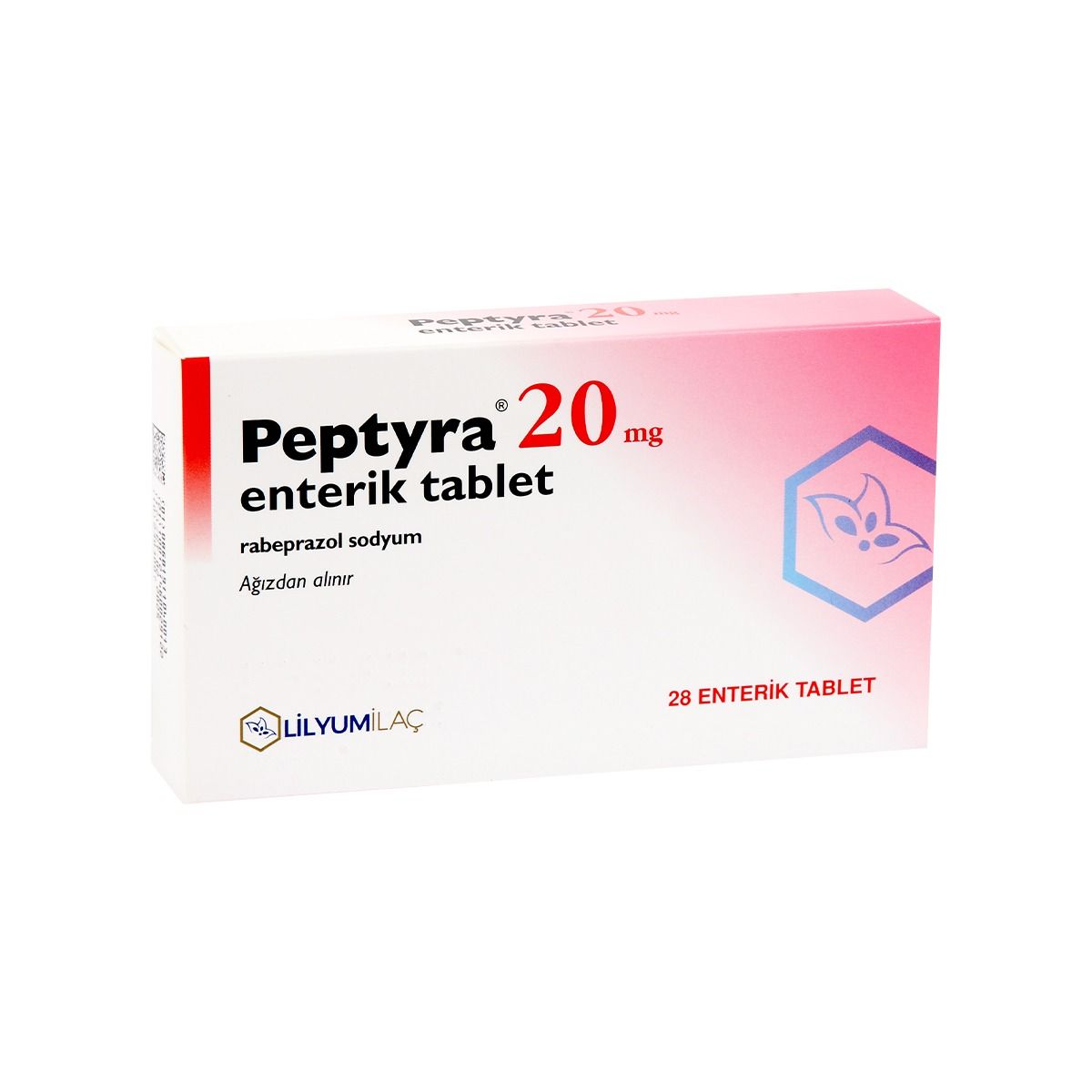
Peptyra - Peptyra 20mg 28 tablet
| Status | Select a city |
| Brand country |  Turkey |
| Quantity and shape | 28 tablets |
| Generics | rabeprazole |















- Description
- Reviews
Peptira 20 mg gastro-resistant tablets
For oral use.
· Active substance(s): Rabeprazole sodium
Each gastro-resistant tablet contains 20 milligrams of rabeprazole sodium, equivalent to 18.85 milligrams of rabeprazole.
· Excipients: Tablet core; magnesium oxide, mannitol, hydroxypropyl cellulose (low substituted), hydroxypropyl cellulose, magnesium stearate. Subcoating; ethylcellulose, magnesium oxide, triethyl citrate. Enteric coating; methacrylic acid copolymer, talc, polyethylene glycol, colloidal silicon dioxide, sodium bicarbonate, sodium lauryl sulfate, yellow iron oxide, titanium dioxide, triethyl citrate.
|
Read this patient information leaflet carefully before you start using this medicine because it contains important information for you. · Keep this leaflet. You may need to read it again. · If you have any further questions, ask your doctor or pharmacist. · This medicine has been prescribed for you only. Do not pass it on to others. · If you go to a doctor or hospital while using this medicine, tell your doctor. · Follow the instructions in this leaflet exactly. Do not use higher or lower doses than recommended for you. |
What is in this leaflet:
1. What Peptira is and what it is used for?
2. What you need to know before you use Peptira?
3. How to use Peptira?
4. Possible side effects
5. How to store Peptira?
1. What Peptira is and what it is used for?
· Peptira is a yellow or almost yellow, round, enteric-coated (gastro-resistant) tablet that reaches the intestines without dissolving in the stomach and is absorbed there thanks to its special, delayed-release, enteric-coated formula. Each enteric-coated tablet contains 20 milligrams of rabeprazole sodium, which is equivalent to 18.85 milligrams of rabeprazole.
· Peptira is sold in aluminum/aluminum blister packaging containing 14 and 28 enteric-coated tablets.
· The active substance of Peptira, rabeprazole sodium, belongs to the class of proton pump inhibitors. Drugs in this class suppress the function of the proton pump system, which plays an important role in gastric acid secretion and is located in certain special cells of the stomach, thereby reducing gastric acid. Reducing stomach acidity helps heal stomach, intestinal, and esophageal ulcers (peptic ulcers) and relieves pain.
Peptira is used to treat patients with active duodenal ulcer, active benign stomach ulcer, symptomatic erosive or ulcerative gastro-oesophageal reflux disease (GORD). GORD is a disease caused by the abnormal passage of stomach fluid into the upper oesophagus, causing erosion or ulcers. Peptira is also used for the long-term treatment of gastro-oesophageal reflux disease (GORD maintenance therapy), to relieve the symptoms of moderate to very severe gastro-oesophageal reflux disease and in Zollinger-Ellison syndrome, which is a condition where the stomach constantly secretes high levels of acid.
Peptira is also suitable in combination with appropriate antibiotics for the eradication of Helicobacter pylori, a bacterium involved in the formation of stomach ulcers.
2. What you need to know before you use Peptira?
Do not use Peptira
- if you are hypersensitive (allergic) to rabeprazole sodium or any of the other ingredients of this medicine,
- if you are pregnant or suspect that you are pregnant,
- if you are breast-feeding.
If you are not sure, consult your doctor or pharmacist before taking Peptira.
Warnings and Precautions
- If you are allergic to other proton pump inhibitors or substituted benzimidazoles (drugs that suppress stomach acid secretion),
- Although blood and liver problems have been reported in some patients, these problems usually improve after stopping Peptira.
- If you have a tumor in your stomach,
- If you have liver problems,
- If you are taking atazanavir for HIV infection,
- If you have reduced vitamin B12 stores or risk factors that may cause vitamin B12 deficiency and have been treated with rabeprazole for a long time. Like all acid-suppressing drugs, rabeprazole sodium may reduce the absorption of vitamin B12.
- If you have had skin disorders such as redness, itching, rash after using similar drugs that reduce stomach acid, such as Peptira.
- Tell your doctor as soon as possible if you develop skin redness or itching, especially when exposed to the sun. You may need to stop treatment with Peptira. Be sure to tell your doctor about any other side effects, such as joint pain.
- If you are due to have a specific blood test (Chromogranin A)
If you are not sure, consult your doctor or pharmacist before taking Peptira.
If you have severe diarrhea (watery or bloody) with symptoms such as abdominal pain or tenderness and fever, stop taking Peptira and contact your doctor immediately.
Taking a proton pump inhibitor such as Peptira, especially for more than a year, may slightly increase the risk of hip, wrist, or spine fractures. Tell your doctor if you have osteoporosis or if you are taking corticosteroids (which can increase the risk of osteoporosis).
If you take Peptira for more than 3 months, your blood magnesium levels may drop. Low magnesium levels can manifest as fatigue, involuntary muscle contractions, disorientation, dizziness, seizures, or a rapid heartbeat. If you notice any of these symptoms, contact your doctor immediately. Low magnesium levels can also lead to a decrease in potassium or calcium levels in the blood. Your doctor may order regular blood tests to monitor your magnesium levels.
Interaction with tests for glandular (neuroendocrine) tumors: The drug-induced decrease in stomach acidity can cause false-positive results in diagnostic tests for tumors of the nervous system and endocrine glands.
If these warnings apply to you, even in the past, consult your doctor.
Taking Peptira with food and drink.
In cases where a single daily dose of treatment is required, take it in the morning, on an empty stomach, with a small amount of liquid.
Pregnancy
Consult your doctor or pharmacist before taking this medicine.
Do not use Peptira if you are pregnant or think you might be pregnant.
If you notice that you are pregnant during treatment, contact your doctor or pharmacist immediately.
Breastfeeding
Consult your doctor or pharmacist before taking this medicine.
Do not use Peptira if you are breastfeeding or planning to breastfeed.
Driving and using machines
You may feel sleepy while taking Peptira. If you feel sleepy, do not drive or use machines.
Important information about some of the excipients of Peptira
There are no excipients that require a warning.
Other medicines and Peptira
Concomitant use of Peptira with preparations containing ketoconazole or itraconazole (substances used to treat fungal infections) may reduce the levels of these preparations in the blood. Your doctor may ask you to adjust the dose.
Concomitant use of Peptira with atazanavir (a medicine used to treat HIV infection) may reduce the level of this medicine in the blood; therefore, these two medicines should not be used together.
If Peptira is used with methotrexate (a substance used in high doses to treat cancer), if you are taking high doses of methotrexate, your doctor may temporarily stop treatment with Peptira.
If you are not sure whether any of the above substances apply to you, consult your doctor or pharmacist before taking Peptira.
If you are currently taking or have recently taken any prescription or non-prescription medicines, please tell your doctor or pharmacist.
3. How to use Peptira?
Instructions for use and dosage/frequency of administration:
Always take Peptira exactly as your doctor has told you.
If you are not sure, check with your doctor or pharmacist.
Adults/Elderly
In the treatment of moderate to severe GORD symptoms (symptomatic GORD), it is used at 10 mg once a day, in the morning on an empty stomach. In this case, treatment with Peptira is expected to last up to four weeks. If your symptoms do not improve within this period, consult your doctor. After this period, your doctor may prescribe a single dose of 10 mg Peptira once a day, as needed, to control symptoms.
In the treatment of very severe symptoms (erosive or ulcerative GORD), the usual dose is one Peptira 20 mg tablet once a day, in the morning on an empty stomach, for four to eight weeks.
During GORD maintenance therapy, for long-term treatment, 10 mg or 20 mg once a day, in the morning on an empty stomach, may be used as prescribed by your doctor. Your doctor will decide how long your treatment will last during GORD maintenance therapy. Your doctor will ask you to visit regularly to review your symptoms and dosage.
The usual dose for stomach ulcer (peptic ulcer) is one Peptira 20 mg tablet once a day, in the morning on an empty stomach for 6 weeks. If your condition does not improve, your doctor may tell you to take Peptira for another 6 weeks.
The usual dose for intestinal ulcer (duodenal ulcer) is one Peptira 20 mg tablet once a day, in the morning on an empty stomach for 4 weeks. If your condition does not improve, your doctor may tell you to take Peptira for another 4 weeks.
To treat ulcers caused by H. Pylori infection and to prevent their recurrence, the usual dose is one Peptira 20 mg tablet twice a day for 7 days. Your doctor will also recommend taking antibiotics such as amoxicillin and clarithromycin. For more information on other medications used to treat H. Pylori, see the patient information leaflet for those medications.
In Zollinger-Ellison syndrome, where there is excess acid production in the stomach, the usual dose initially is three Peptira 20 mg tablets once a day. Your doctor may then adjust your dose depending on your response to treatment. If you are taking long-term treatment, you should see your doctor regularly to review your symptoms and dose.
Patients with liver problems should consult their doctor at the beginning of Peptira treatment and throughout the course of Peptira treatment.
Route and method of administration:
- Remove one tablet from the blister only when it is time to take the medicine.
- Swallow the Peptira tablet whole with a sip of water. Do not chew, break or crush the tablet.
- The doctor will decide how many tablets you should take and for how long.
- If you take this medicine for a long time, your doctor will monitor your condition.
Different age groups:
Use in children:
The use of Peptira in children is not recommended.
Use in the elderly:
There is no special use.
Special cases of use:
Renal/hepatic impairment:
Dose adjustment is not necessary in patients with renal or hepatic impairment. However, caution is advised in patients with severe hepatic impairment.
If you think that the effect of Peptira is too strong or too weak, tell your doctor or pharmacist.
If you take more Peptira than you should:
Do not take more tablets than your prescribed daily dose.
If you take more Peptira than you should, tell your doctor or pharmacist.
If you forget to take Peptira:
If you forget to take a dose, take it as soon as you remember. However, if it is time for your next dose, skip the missed dose and then continue taking the medicine as usual.
Do not take a double dose to make up for a forgotten dose.
If you forget to take the medicine for more than 5 days, consult your doctor before taking it.
If you stop taking Peptira
Relief of symptoms will usually occur before the ulcer is completely healed. It is important not to stop taking the tablets until your doctor tells you to.
If you have any further questions on the use of this medicine, ask your doctor or pharmacist.
4. Possible side effects
Like all medicines, this medicine can cause side effects, although not everybody gets them.
Side effects are usually mild and improve without stopping this medicine.
If you notice any of the following symptoms, stop taking Peptira and contact your doctor immediately or go to the nearest emergency department:
· Allergic reactions, including sudden swelling of the face, difficulty breathing or low blood pressure, which may cause fainting,
· Frequent infections such as sore throat or high temperature (fever), or ulcers in the mouth or throat,
· Bruising or bleeding easily.
These side effects are rare.
· Severe skin blistering or pain, ulcers in the mouth or throat.
These side effects are very rare.
If you have any of these, you have a serious allergy to Peptira. You may need urgent medical attention or hospitalization.
If you notice any of the following, tell your doctor:
The frequency of side effects is as follows:
Very common: may affect at least 1 in 10 patients.
Common: may affect less than 1 in 10 patients, but more than 1 in 100 patients.
Uncommon: may affect less than 1 in 100 patients, but more than 1 in 1,000 patients.
Rare: may affect less than 1 in 1,000 patients, but more than 1 in 10,000 patients.
Very rare: may affect less than 1 in 10,000 patients.
Not known: frequency cannot be estimated from the available data.
Common:
- Infections
- Difficulty sleeping
- Headache, dizziness
- Cough, runny nose or inflammation of the pharynx (throat),
- Effects on the stomach or gut such as stomach pain, diarrhoea, flatulence, feeling sick (nausea), being sick (vomiting) or constipation.
- Pain or back pain
- General weakness, flu-like illness
- Benign polyps in the stomach
Uncommon:
- Irritability or sleepiness
- Chest infection (bronchitis)
- Painful or blocked sinuses (sinusitis)
- Dry mouth
- Indigestion or burping
- Skin rash or redness
- Muscle, leg or joint pain
- Hip, wrist and spine fractures
- Bladder infection (urinary tract infection)
- Chest pain,
- Chills/shivering or fever
- Changes in liver function (shown in blood tests)
Rare:
- Loss of appetite (anorexia)
- Depression
- Increased sensitivity (including allergic reactions)
- Visual disturbances
- Mouth pain (stomatitis), taste disturbance
- Stomach discomfort or stomach pain
- Liver problems, including yellowing of the skin and whites of the eyes (jaundice)
- Itchy rash or blisters on the skin
- Sweating
- Kidney problems
- Weight gain
- Changes in white blood cells (shown in blood tests), which leads to frequent infections
- Decrease in the number of platelets, which leads to bruising or bleeding more easily than usual
Very rare:
- A skin disease characterized by symmetrical, red, and raised areas of skin all over the body
(Erythema multiforme)
- A skin disease characterized by blistering and peeling of the skin (Toxic epidermal necrolysis - TEN)
- A condition that can develop in response to medications or infection and involves painful
red or purple rash and blisters that spread on the skin (Stevens-Johnson syndrome (SJS))
Unknown:
- Swelling of the mammary glands in men
- Fluid retention
- Inflammation of the digestive tract (which causes diarrhea)
- Decrease in blood sodium levels, which can cause confusion and fatigue, muscle twitching, seizures, and coma
- Encephalopathy (brain disease) may occur very rarely in patients who have previously had liver problems.
- Redness and itching of the joints, which may be accompanied by pain
If you notice any side effects not listed in this leaflet, please inform your doctor or pharmacist.
Reporting of side effects
If you notice any side effects, whether or not they are listed in the package leaflet, please contact your doctor, pharmacist, or nurse. By reporting side effects, you can help provide more information on the safety of the medicine you are using.
5. How to store Peptira?
Keep this medicine out of the sight and reach of children, in its original packaging.
Store at room temperature below 25°C. Do not refrigerate.
Use in accordance with the expiry date.
Do not use this medicine after the expiry date stated on the packaging.
Do not use Peptira if you notice any defects in the product or its packaging.
Do not throw away expired or unused medicines in the trash! Hand them over to the collection system determined by the Ministry of Environment, Urbanization and Climate Change of the Republic of Turkey.
Also, see: Rabezol 20mg 28 Tablets
Translated by AI


